Joshua Ramlakhan
DESIGN IV PROJECT
OBJECTIVE:
-
-
The objective of Project 1 will be to add short term corporate worker housing to the given site. Specifically, the scope of work for this project is to provide incubator housing to individuals entering the workforce, who cannot afford to rent locally. Proposed worker's housing is to accommodate 2% of Swiss Air's workforce (based on occupancy)
-
PROJECT: SwissAir HQ Addition

Side Elevation of Existing Building

Rear Elevation of Existing Building

Front Elevation of Existing Building

ZONING ANALYSIS
Address : 41 Pinelawn Road, Melville, NY 11747
Tax map # 0400-255.00-01.00-017.000
Lot size : 5 Acres
Land use : Commercial C-2 Office Building District
Overview: The C-2 District is designed for moderate-intensity office and research uses, typically serving as a buffer between industrial or high-intensity areas and residential neighborhoods.
Allowed Uses: Office buildings. Research and testing institutions for electronic, electrical, and mechanical devices (as long as there's no noticeable noise, vibration, odor, or dust outside).Accessory uses like cafeterias, daycares, auditoriums, storage (inside only), signs, and parking. Limited product sales are allowed if incidental to the main use.
Not Allowed: Outdoor storage or sales of products or materials.
Parking & Loading Rules:
Parking must be set back from property lines (20 ft from front, 15 ft from street sides, 10 ft from interior lines, 20 ft from residential areas).
Landscaping is required around parking areas.
Overnight fleet parking must be shown on the site plan and not placed in front or street-side yards. Loading areas must be at the side or rear, away from residential zones and streets.
Additional Notes:
Building plans must be reviewed and approved by the Planning Board before permits are issued.
Exterior security gates are not allowed on storefronts in the Huntington Village Business Improvement District. Any existing gates must be removed if ownership or tenancy changes.
Interior security gates and gates for garage or loading areas are allowed.
Appeals for prohibited gates can be made in cases of serious financial or security hardship.

The Site
BACKGROUND RESEARCH
Workers Housing
Barrow Island Model Village, England (1890s)
-
Developer: Barrow Shipbuilding Company
-
Visionary/ Planner: Sir James Ramsden
-
The Barrow Island Model Village in England was built in the 1890s to provide housing for workers of the Vickers Shipbuilding and Engineering company. The village was designed to offer a high standard of living for the workers and their families, with well-planned streets, green spaces, and community facilities. This initiative aimed to improve the quality of life for the workers, promote social welfare, and create a sense of community among the residents.
-
Architectural Characteristics:
-
Victorian Architecture: Characterized by its ornate detailing, steeply pitched roofs, and vibrant colors, Victorian architecture was prevalent during the late 19th century and influenced the design of the village
-
-
About:
-
Streets were laid out in a rational grid pattern, reflecting Victorian planning ideals of order and hygiene. This also facilitated easy access to the shipyards and industrial zones.
-
This style emphasized well-planned streets, green spaces, and community facilities to promote social welfare and create a sense of community among the residents
-


Gunkanjima (Hashima Island), Japan (1890s- 1974)
-
Developer: Mitsubishi
-
Significance:
-
Japan's first reinforced concrete high rise
-
Every structure served a utilitarian purpose—housing, mining, or infrastructure—with minimal ornamentation.
-
Self- Contained Infrastructure, the island had schools, hospitals, shops, and even rooftop playgrounds which is an early example of vertical urbanism.
-
-
ABOUT:
-
Coal Discovery: First found in 1810, with full-scale mining starting in the late 1800s
-
Mitsubishi Ownership: The company bought the island and rapidly developed it into a mining colony
-
Population Peak: Over 5,000 residents lived there in the 1950s–60s, making it the most densely populated place on Earth at the time
-
The island was a self-contained city: it had schools, shops, a hospital, and even a movie theater
-
Half the island was devoted to mining operations, the other half to residential life
-
High-rise concrete buildings were built to withstand typhoons and earthquakes—Japan’s first of their kind
-


APPLYING ROWE'S THEORY TO HISTORICAL WORKERS HOUSING
Gunkanjima island (Hashima), Japan:
PROBLEM FRAMING
-
Engineers faced extreme constraints: limited land, typhoon exposure, seismic risk, and industrial demand.
-
It wasn't shaped by ego or aesthetics, but by adaptive problem- solving.
HYPOTHESIS FORMATION
-
Solutions emerged like reinforced concrete buildings, vertical housing, and rooftop spaces—early experiments in compact urbanism.
CONTEXTUALISM
-
The island’s design responded directly to its harsh marine environment and industrial purpose. No decorative excess—just raw functionality.
USE OF PRECEDENT
-
Designers adapted techniques from mainland Japan and early modernist principles, especially in earthquake-resistant construction.
Barrow Island Model Village, England:
-
PROBLEM SOLVING : Industrial demand, limited land, and a need for rapid housing solutions.
Rowe would interpret this as a tightly framed problem with clear functional and contextual boundaries.
-
HYPOTHESIS FORMATION Tenement blocks, dock infrastructure, and proximity-based planning to reduce commute and maximize productivity.
These hypotheses reflect Rowe’s idea of “design propositions” formed from precedent and logic.
-
CONTEXTUALISM: Design responded to the harsh coastal climate, industrial logistics, and social needs of a working-class population.
This aligns with Rowe’s view that design is shaped by cultural, environmental, and historical cues.
-
ITERATION: The island evolved through successive waves of development, adapting to changing technologies and labor demands.
Rowe’s theory allows for historical evolution as a form of design feedback—even across decades.
41 Pinelawn Road - Existing Conditions
EXISTING PLANS ANALYSIS
FIRST FLOOR PLAN


EXISTING REAR PLAN

EXISTING RIGHT SIDE ELEVATION

EXISTING FRONT ELEVATION

EXISTING LEFT SIDE ELEVATION

SUN DIRECTION SUN PATH

SPRING

FALL

SUMMER

WINTER
Contextual Diagrams


RENDERINGS


Housing Addition
Corporate housing must be more than simply economical shelter. It must provide meaningand community for its residents. If reduced only to efficiency and cost, such housing risksalienating workers and signaling that their contributions are undervalued. The architecturalchallenge is then to develop designs that balance contextual fit with meaning and dignity,fostering both individual well-being and collective identity
1. Anthropometric Analogies – using the human body and its movement through space as a guide.
2. Literal Analogies – borrowing existing forms, either:o Iconic: symbolic or natural references (e.g., Sydney Opera House’s shell-likeroof).o Canonic: abstract proportional systems (e.g., grids, platonic solids).
3. Environmental Relations – designing in response to climate, materials, behavior, andcontext.
4. Typologies – adapting and reinterpreting architectural precedents and organizationalmodels.
5. Formal “Languages” – employing rule-based systems, whether classical, patterned, orpersonally developed (modern, post-modern, deconstruction, Meier’s style, etc.).
Preliminary Design 1
Idea: Swissair Logo
Heuristic : Literal Analogy (Iconic)

A literal, iconic transformation, turning the Swissair logo into corporate housing.
“With a winged silhouette overhead, employees are cleared for takeoff.”
Circulation Diagrams

Entrance
1st Floor

2nd Floor

Roof Render

Rendered Elevations

East Elevation


West Elevation
North Elevation
Axonometric Views

South West View

South East View

North East View

North West View
Interior Views
View from the back balcony looking into buildings

View from left staircase looking down the hallway

Additional Renders


Preliminary Design 2
Idea: Richard Meirer's Style
Heuristic: Formal Language
A culmination of Richard Meirers formal language and style.
Meier's Work that served as Inspiration
"A Meierian crescendo, orthogonal rigor, radiant calm"


The Anthenum
High Musuem of Art
Swiss Air Headquaters
Circulation Diagrams
1st Floor

2nd Floor

3rd Floor

Rendered Elevations
Roof Render
North Elevation


East Elevation
West Elevation

Axonometric Views

North East view

South West View

North West View

South East View
Additional Renders


Preliminary Design 3
Idea: Sun Oriented for Max Solar Gain
Heuristic: Environmental Relations
"Solar Gain by design, Not by chance"
Circulation Diagrams
1st Floor

2nd Floor

3rd Floor

Rendered Elevations
Rendered Roof Plan

Rendered Elevations


West Elevation
North Elevation

East Elevation
Axonometric Views

North East View

South East View

South West View

North West View
Additional Renders


FINAL DESIGN
Chosen: Preliminary Design 1: Swiss Air Logo
Heuristic: Literal Analogy (Iconic)
OLD

NEW

Swot Analysis Report: Based on External Reviewers Comments
SWOT Report: Swissair Headquarters Works Housing Addition
Location: 41 Pinelawn Road, Melville, NY
Design Heuristic: Iconic/ symbolic Metaphor: inspired by the Swiss Air's Logo, with aspects of Richard Meir's formal language
Strengths:
1. Iconic Meier-Driven Concept with Strong Symbolic Fit
Clearest concept via an iconic metaphor, which directly ties into Swissair's identity and headquarters purpose. Reads as quickly, and the addition is more than a formal gesture.
2. Strong Connection to the Existing Building
The addition connects to the pre-existing in a straightforward and integrated way, reinforcing continuity between old and new/ work and housing.
3. Powerful Contrast as a Design Strategy
An intentional polar opposite to Meier's building, creating a powerful and bold structure.
4. Clear Circulation and Spatial Legibility
Circulation through the building is clear, concise, and functional.
5. Strong Public–Private Differentiation
Strong distinction between public and private life, supporting comfort and privacy.
6. Effective Use of Meier’s Formal Language and Structural Components
Utilization of Meier's formal language gives the building a sense of familiarity without it being a soulless copy.
7. Intentional Light Strategy
Daylight is prioritized in public/ communal spaces, while private quarters get more controlled light.
8. Respect for the Formal Entrance
The building is shaped around the formal entrance, which avoids the addition from overshadowing the original.
9. Weather-Responsive Roof Move
A tilted roof is not only a design feature but also functional.
Opportunities:
1. Make the Communal Space Larger and the Formal Front Door
Enhancing the communal space by making it larger, but also the building's formal entrance, creating a true lobby area.
2. Increase Setback from the Headquarters
Increasing the distance from the pre-existing building to the addition so workers feel like they are "home," not still at work.
3. Enhance Skylights to Strengthen the Plane Metaphor
Enhancing the skylights in the roof to make it more expressive, further reinforcing the plane metaphor, and improving daylight quality
4. Adjust Second-Floor Room Layout to Meet Unit Requirements
Moving the rooms on the second floor outward to fit the unit's total requirements
Weaknesses:
1. Lack of Formal Entrance
The building lacks a clear, dedicated main lobby.
2. No True Lobby Space
The building has no defined lobby space, and workers have no transitional space.
3. No Elevators
No elevators create an accessibility conflict.
4. Apartment Count Does Not Meet Requirements
Total amount of units does not meet the program requirements.
5. Community Space Size vs Daylight Tradeoff
Communal space is too small; increasing its size will cause problems for the upper floors' light/ egress requirements.
Threats:
1. Two-Story Communal Space Could Block Apartment Windows
By making the communal space a two-story space, the windows of the apartments will be blocked by it, threatening livability.
2. Second-Floor Extension Increases Structural Demands
By moving the rooms on the 2nd floor outward, the floor becomes considerably longer, and structural support will be a concern.
3. Roof Must Change to Accommodate a New Formal Entrance
The roof will have to be altered to satisfy a newly added formal entrance.
Conclusion
The proposed Swissair Workers Housing addition demonstrates a sophisticated yet familiar application of a metaphoric symbol rooted in applications of Meier's language and structural components. The SWOT analysis highlights strong conceptual clarity, an iconic yet legible form closely tied to the Swissair logo, a clear public–private organization, intuitive circulation, and careful use of light that integrates the addition with the existing headquarters without overpowering its formal entrance. At the same time, it identifies key areas for refinement—formal entry and lobby definition, vertical circulation, apartment count, and structural and daylighting implications of future adjustments, suggesting that, with continued development, the project can fully reconcile symbolic expression, technical performance, and everyday livability for its workers.
Design Adjustments
Based on the external reviewers' comments and the professors' comments, changes were made, which include:
1. Extending the 2nd Floor to meet the total unit requirement while supporting the extended structure with a Meirer-like beam.
2. Scrapping the original communal space and creating a lobby space and a communal space through the use of a true formal entrance
3. Changing how the skylights are positioned and adding an incline area to give the idea of a plane tail, further reinforcing the plane metaphor.
4. Increased the distance from the pre-existing building to make it so workers felt more at home.
5. Added elevators to help with accessibility and added egress doors on the edge of the 1st floor hallways to minimize dead-end corridors.
6. Created an open to below area to give the building more of an awe-inspiring feature.
Proposed Final Floor Plans

RECEPTION / OFFICE
STUDIO
STUDIO
ELV.
LAUNDRY
ROOM
ST.

ELV.

COMMUNITY AREA
ELV.
STUDIO
STUDIO
STUDIO
STUDIO
LAUNDRY
ROOM
ELV.
STUDIO
ST.
RECEPTION/
OFFICE
First Floor Plan

STUDIO
STUDIO
STUDIO
STUDIO
HALLWAY
DUPLEX
STUDIO
STUDIO
STUDIO
STUDIO
DUPLEX
ELV.
ELV.

STUDIO
HALLWAY
ELV.
STUDIO
DUPLEX
DUPLEX
ELV.
STUDIO
STUDIO
STUDIO
STUDIO
STUDIO
STUDIO
OPEN TO
BELOW
Second Floor Plan
Proposed Unit Floor Plans
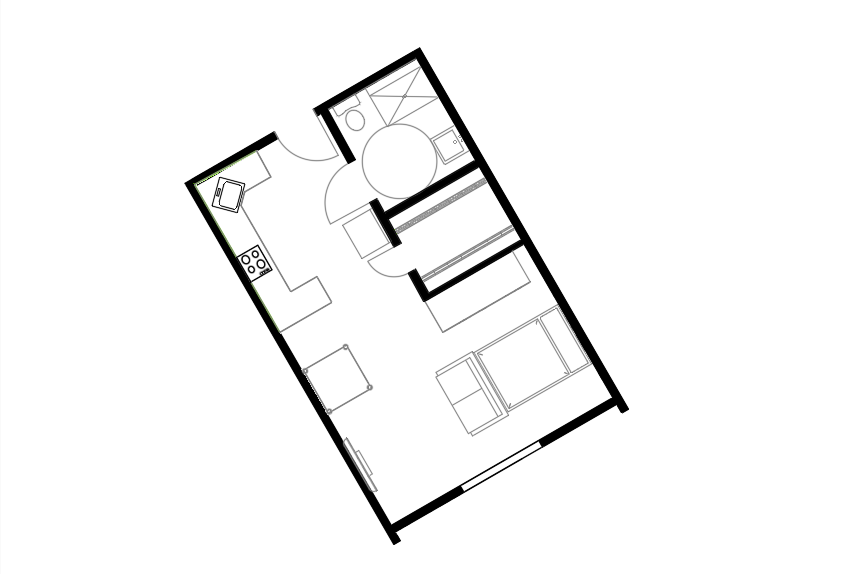
KITCHEN
BATHROOM
CLOSET/ PANTRY
LIVING ROOM
BED
WARDROBE

HALLWAY
CL.
BATH
KITCHEN
LIVING ROOM
BEDROOM

HALLWAY
CL.
BEDROOM

BEDROOM
LIVING ROOM
KITCHEN
BATH
CL
Proposed Studio
Proposed Duplex
Proposed Final Rendered Elevations

North Elevation

East Elevation

West Elevation
Proposed Final Rendered Plans


Rendered Roof Plan
Proposed Final Sections

Longitudinal Design Section

Construction Section


Construction Details
Proposed Final Axonimetric Rendered Views
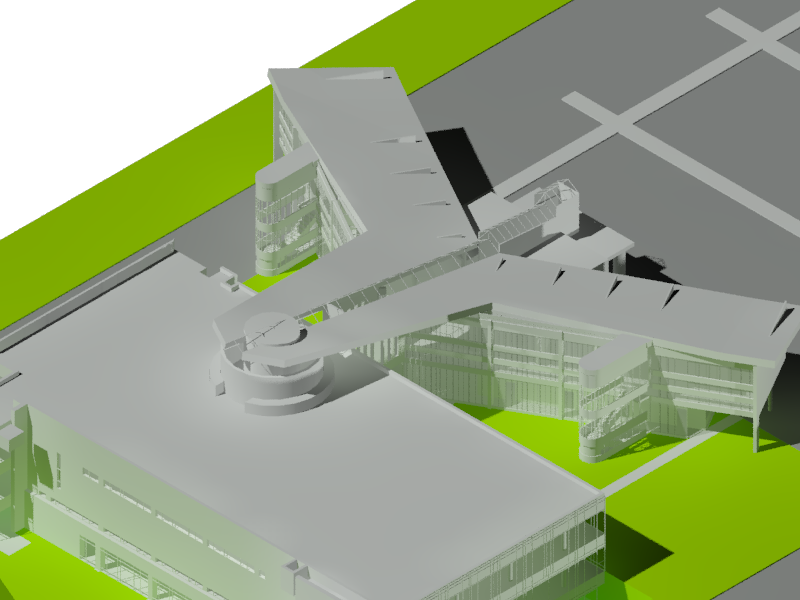
South West View

South East View

North East View

North West View
INTERIOR RENDERS

Co-Pilot Duplex

Co-Pilot Studio

Co-Pilot Lobby/ Community Space
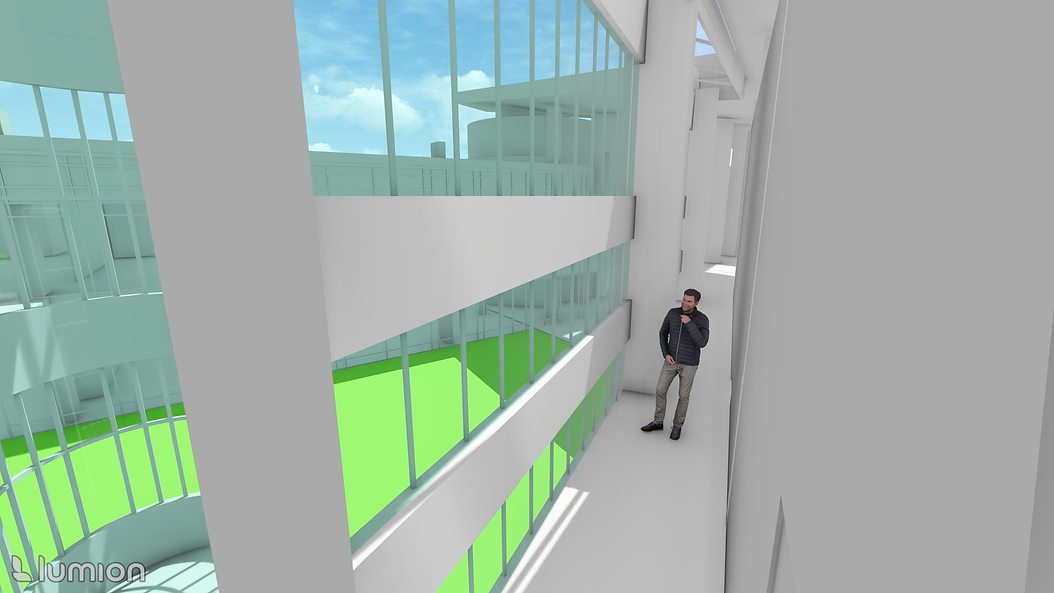
Lumion Hallway from Stairs

Lumion Heading into Building
EXTERIOR RENDERS

Lumion South West View
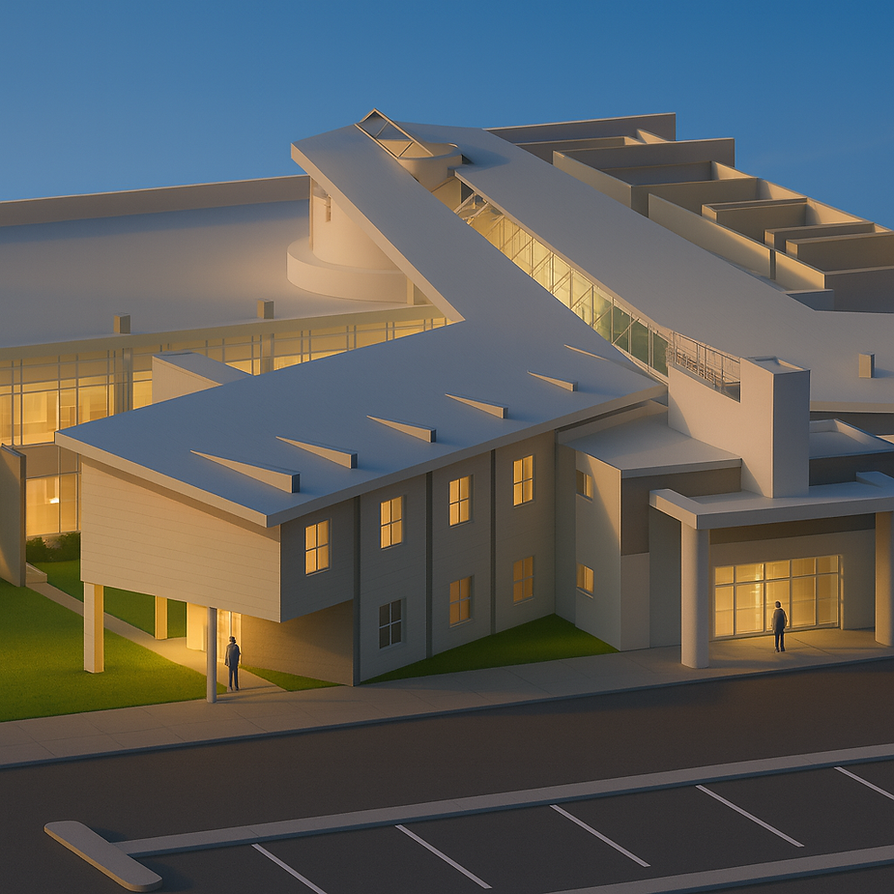
Co-Pilot North West View at Night

Lumion South East at Sunrise

Lumion North East at Sunrise

Formal Entrance Close Up
SURROUNDING AREA RENDERS


RENDERED 3D SECTIONS


3D SECTIONS
VIDEO


